
3 June 2026
8 Benefits of Using a Shuttle Bus in Cyprus
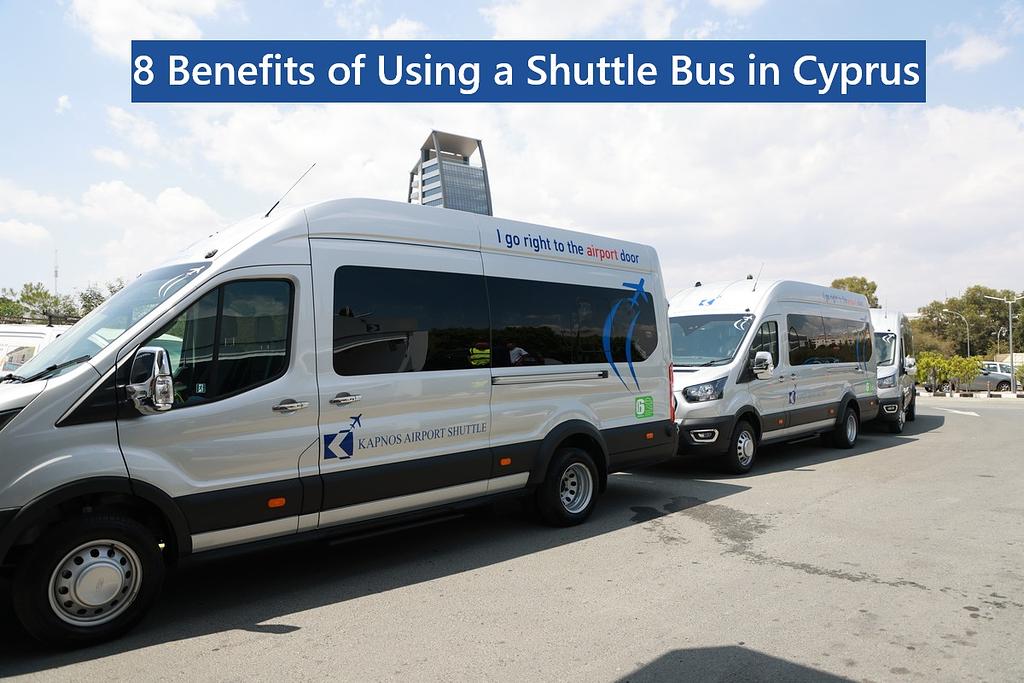
Cyprus has two international airports, Larnaca and Paphos, and no national rail network. The island's railway ceased operations in 1951, leaving road transport as the only option for the 4.53 million tourists who arrived in 2025, as well as residents moving between Nicosia, Limassol, Agia Napa, and Protaras. For that journey, three options exist: a private taxi costing upwards of €50, a local public bus that stops at municipal points and requires at least one transfer, or a dedicated airport shuttle running fixed routes at a fraction of the cost.
The Kapnos Airport Shuttle connects both airports to the island's main urban centres with over 100 daily departures and fares starting at €9 on the Nicosia to Larnaca route. Whether you are managing luggage for a family trip, coordinating arrivals for a corporate event, or arranging student group transfers, the sections below detail the benefits of choosing a shuttle.
What are the benefits of using a shuttle bus in Cyprus?
Using a shuttle bus offers 8 distinct advantages: environmental protection, passenger safety, cost reduction, schedule reliability, direct airport-to-city routes, interior comfort, congestion reduction, and no requirement for airport parking. These benefits follow from three features common to all shuttle operations: shared passenger capacity, fixed routes, and scheduling built around airport departures and arrivals. The sections below detail each in full.
1. Environmentally Friendly
A shuttle bus carries up to 50 passengers in a single Euro 6-standard vehicle, reducing per-passenger CO₂ emissions from approximately 170 grams per kilometre in a private car to as low as 50-60 grams at full occupancy (Carbon Independent; ICCT, 2016). Euro VI certification for heavy-duty vehicles limits nitrogen oxides to 0.4 grams per kilowatt-hour and particulate matter to 0.01 grams per kilowatt-hour, representing an 80% reduction in NOx and a 67% reduction in particulate mass compared to the previous Euro V standard (ICCT, 2016; European Commission).
These are the pollutants most associated with urban air quality damage according to the European Environment Agency and the World Health Organisation, with the standard requiring compliance under real-world driving conditions (ICCT, 2016). Kapnos Airport Shuttle added 5 new Euro 6-standard buses to its fleet in 2024, bringing more of its vehicles into compliance with the highest current EU emissions standard. On a 50-kilometre route like Nicosia to Larnaca Airport, a single full shuttle replaces up to 50 individual car journeys.
2. Safety and Comfort
A shuttle bus operates under documented safety controls that cover every stage of the passenger journey. ISO 39001:2012 certification, which Kapnos Airport Shuttle became the first passenger transport company in Cyprus to achieve in 2017, requires verified maintenance schedules, driver licence checks, ongoing safe-driving training, and on-site audits by an independent third-party certification body.
Compliance is not self-reported: the standard mandates measurable objectives, active monitoring of driver behaviour, and annual surveillance audits following initial certification. On board, passengers travel in air-conditioned cabins with reclining seats, free Wi-Fi, and USB charging ports.
3. Cost-Effective Travel
A shuttle bus spreads operational costs across all passengers, keeping individual fares fixed regardless of demand. A standard adult ticket from Nicosia to Larnaca International Airport costs €9, compared with upwards of €50 for the same route by private taxi.
That fare includes one carry-on bag and one checked bag weighing up to 20 kilograms, meaning a family of four travels with their full luggage for €36 rather than negotiating taxi rates or paying for a larger private vehicle.
4. Reliable Schedules
A shuttle bus runs to a published timetable regardless of passenger volume, operating from approximately 05:00 to 23:00 to align with flight schedules at both Larnaca and Paphos airports. On the Nicosia to Larnaca route, departures run every 30 minutes during peak summer months and hourly during winter.
With over 100 daily departures across the network, passengers can plan their arrival at the airport around a fixed departure time and a known journey duration, rather than estimating based on traffic or taxi availability.
5. Convenient airport-to-city connections
A shuttle bus connects Larnaca and Paphos airports directly to Nicosia, Agia Napa, and Protaras, with no intermediate transfers or route changes. Passengers board at designated zones at each airport and are dropped off at fixed city stations: the Central Kapnos Bus Station in Nicosia, named stops on Nissi Avenue and the main square in Agia Napa, and Pernera Avenue and Avenue 3 stops in Protaras.
The network expanded to the Famagusta area in 2018, giving eastern coastal resorts a direct airport transfer option that previously required a connection through the city.
6. Comfortable and practical
A shuttle bus on a 40- to 100-minute airport route is designed to meet the specific needs of travellers in transit. Air-conditioned cabins manage Cyprus's summer heat without passengers needing to plan around it. Reclining seats and free Wi-Fi make the journey productive or restful, depending on preference.
USB charging ports on every new vehicle mean passengers arrive at the airport with charged devices rather than depleted ones. Electric doors with integrated obstruction sensors improve boarding speed and reduce injury risk in busy zones, and the wider opening assists passengers travelling with large luggage or reduced mobility.
7. Reduced Traffic Congestion
A shuttle bus at full capacity carries up to 50 passengers, replacing up to 50 individual car journeys on a single trip, assuming the Cyprus average of one passenger per private vehicle on airport routes. At airports, where private car drop-offs and taxi queues concentrate at narrow access points, fewer individual vehicles arriving means shorter queues at entrances and less congestion at drop-off zones.
8. No Parking Stress
A shuttle bus drops passengers outside arrivals, bypassing airport parking entirely. During peak summer periods, Larnaca Airport parking regularly reaches capacity, with closed entrances, congested drop-off zones, and long-stay areas located far from terminal entrances.
Leaving a vehicle in long-term airport parking also means returning to it after travel, often late at night, in an unfamiliar zone. Passengers using the Kapnos shuttle instead leave their car at the Nicosia Shuttle Station on Kyrenia Avenue, where parking is free, and board directly for the airport. The journey cost remains €9. The parking cost is zero.
How do these benefits transform your travel experience?
Cyprus airport transfers between Larnaca, Paphos, and the island's major cities become simpler when transport is reliable, affordable, and scheduled. Families boarded with their luggage accounted for and a fixed €9 fare in hand. Corporate groups land and move without coordination gaps. Students travel on timetables that hold.
Across all of these, the 200-vehicle Kapnos network delivers the same outcome: a journey that costs less, emits less, and removes the parking, transfers, and uncertainty that other options entail. Cyprus airport transfers do not have to mean negotiating taxi fares, dragging luggage through bus connections, or circling for a parking spot. Book a seat on the Kapnos Airport Shuttle and arrive knowing exactly what the journey costs, how long it takes, and where it ends.